
Optimization of Generators
Author
Brandon Louw (Pr.Eng.)
Understanding the Impact of Low Load Operation
Standby and prime rated generators are designed to operate between 50-85% of faceplate value. Operating a diesel generator set at load levels less than 30% of rated output for extended time periods impacts the unit negatively. The most prevalent consequence is engine exhaust slobber, commonly known as wet stacking. Engine slobber is a black, oily liquid that can leak from exhaust manifold joints due to extended low- or no-load scenarios. Running at high idle with little or no load reduces the heat in the cylinder, allowing unburned fuel and oil deposits to leak through the exhaust slip joints.
Long periods of light loading will lead to deposit build-up behind the piston rings, deposits developing inside the cylinders, and, in extreme cases, cylinder liner polishing can occur. These conditions will cause power losses, poor performance and accelerated wear of components, ultimately leading to an increase in operational maintenance and unplanned downtime.
This highlights the need for optimization and provides the perfect opportunity to recover operational and maintenance losses.
Common Optimization Constraints
The goal is to utilize and balance loading profiles on generators that are underutilized at the premises, while making use of existing infrastructure, where possible. Most prevailing problems found when trying to optimize a generator would be:
Existing Infrastructure Layout
This would suggest location of the generator (source) to location of distribution (control) to location of consumption (load). It is very seldom that one would find an easy optimization solution, and physical alternation tend to be necessary.
Generator Age:
The alternator and engine age does in fact affect the expected outcome when optimizing your generator. Natural degradation of mechanical parts is the root cause of the lower efficiency of the generator. This phenomenon is not significant and would indicate a fault on the unit, if fuel usage increases substantially.
Existing Load Power Factor
Generators run best with highly resistive loading, despite the fact that such scenario is nearly impossible to find in general commercial and industrial settings. The best way of improving on this would be to introduce more resistive loading onto the generator and/or a RC based load.
Harmonic Pollution
Switched mode power supplies, especially the product ranges producing modified sinewaves and cheaper ways of inverting battery banks for backup usage creates harmful and undesirable harmonics onto the network. It might not be as significant to a transformer, but generators don’t take these harmonics lightly.
Generator Brand
Alternators and engines differ in performance based on manufacturer. Some brands deal well with startup load, while others perform less optimal. Generator attack time is notably different when using a mechanical governor as to its electronic counterpart.
High Inertia Loads
Impact power factor is something to take into consideration. It can single handedly stall a generator, making one think the generator is overloaded. Most of the time electrical machinery are old, faceplates are worn, and impact pf is unknown. It would be easiest to log the generator and identify your impact power factor.
Optimization Techniques
Micro-grid enabled time shifting strategy
This technique is applicable to a tied bus with multiple generators. Generator fuel consumption can optimally be controlled by means of a control system that analyzes the load and switches generators on/off based on the demand.
Step-load distribution
A single generator can be optimized to accept higher load by introducing a time-based load management system. This will allow loads to be dynamically connected and/or disconnected as the generator starts up and runs continuously.
Fueling System
The supply chain of diesel from point of creating the fuel, distributing it up to the point of decanting it into the generator allows for microbial contamination of diesel. These micro-organisms feed of hydrocarbons and die off, leaving a layer of diesel sludge over time. An easy way of improving a generator’s lifespan and performance is by adding chemicals to break down this sludge or adding a fuel scrubbing system before injecting it into the engine.
Expected Optimization Outcomes
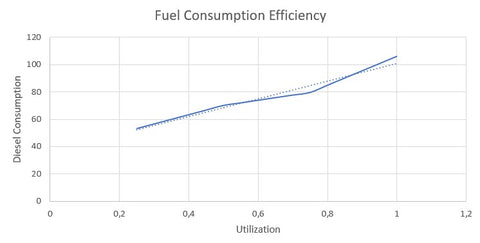
Based on the near linear relationship between utilization factor and diesel consumption we could project consumption loss to power utilized for an existing 500kVA generator. The graphical representation of the generator’s diesel consumption to its linear projected consumption, indicates that the generator is best operated between 60% to 83% of rated standby load.
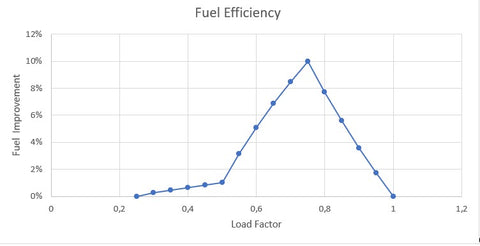
The generator fuel efficiency is based on engine efficiency to load factor. Once a generator is adequately loaded, it is expected for fuel consumption to decrease slightly. The graphical representation as indicated below shows that a theoretical 10% improvement on fuel consumption can be expected, when loaded at 77% of rated standby power.
In conclusion, optimizing generator performance is not merely a matter of improving efficiency; it’s about safeguarding against costly operational setbacks and maximizing the lifespan of critical equipment. By understanding the impact of low load operation, addressing common optimization constraints, and implementing effective strategies, businesses can achieve significant savings in both fuel consumption and maintenance costs while ensuring reliable power generation. With the right approach to generator optimization, organizations can enhance their operational resilience and maintain uninterrupted productivity, even in the face of challenging circumstances.
In conclusion, optimizing generator performance is not merely a matter of improving efficiency; it’s about safeguarding against costly operational setbacks and maximizing the lifespan of critical equipment. By understanding the impact of low load operation, addressing common optimization constraints, and implementing effective strategies, businesses can achieve significant savings in both fuel consumption and maintenance costs while ensuring reliable power generation. With the right approach to generator optimization, organizations can enhance their operational resilience and maintain uninterrupted productivity, even in the face of challenging circumstances.
Contact Us
Address
Unit 30, Sildale Park, 150 Conveyer Rd, Silvertondale, Silverton, 0181
Phone
+27 (0)12 012 6173
Follow Us











Brandon and his team are professional, responsive, and genuinely care about meeting our needs. Communication is clear and timely, and they go above and beyond to make sure everything is handled smoothly.
Highly recommend 💯