Injection Testing:
A Complete Guide
Introduction to Injection Testing in Electrical Engineering
Injection Testing is one of the most critical practices in modern electrical engineering. For AIS Electrical Engineers, it ensures that circuit breakers, relays, and protective devices operate exactly as designed under both normal and fault conditions. By mastering both Primary Injection Testing and Secondary Injection Testing, engineers can maintain system reliability, minimize downtime, and uphold safety standards.
Both methods serve distinct but complementary roles in verifying the functionality of protection systems. Let’s explore them in detail.
What is Primary Injection Testing?
Primary Injection Testing applies a high current directly through the primary side of a breaker or protective device. This validates the entire protection chain, from sensors to trip coils, simulating real-world conditions to ensure proper operation.
What is Secondary Injection Testing?
Secondary Injection Testing bypasses the high-current path by injecting signals into the relay’s secondary circuits. This method checks protective relay logic, trip mechanisms, and communication without stressing the full current path.
Importance of Testing in Power Systems
Testing is vital for several reasons:
- Ensures Circuit Breaker Reliability: Prevents malfunctions during real faults.
- Prevents Costly Downtime: Identifies weaknesses before they cause outages.
- Improves Workplace Safety: Confirms relays and breakers respond fast enough to protect people and equipment.
Primary Injection Testing Explained
Purpose of Primary Testing
Simulates actual fault conditions to validate the entire protection circuit.
How It Works
- High current passes through the breaker’s primary circuit.
- The tripping mechanism and response time are measured.
- Results are compared against manufacturer specifications.
Applications
- Testing high-voltage circuit breakers
- Verifying CT (Current Transformer) performance
- Validating complete protection systems
Secondary Injection Testing Explained
Purpose of Secondary Testing
Ensures that the relay logic and protection schemes work correctly.
How It Works
- Simulated signals are injected into the relay.
- The relay’s trip function and logic are monitored.
- Accuracy and communication are verified.
Applications
- Relay performance checks
- Functional testing of protection logic
- Quick testing without stressing the system
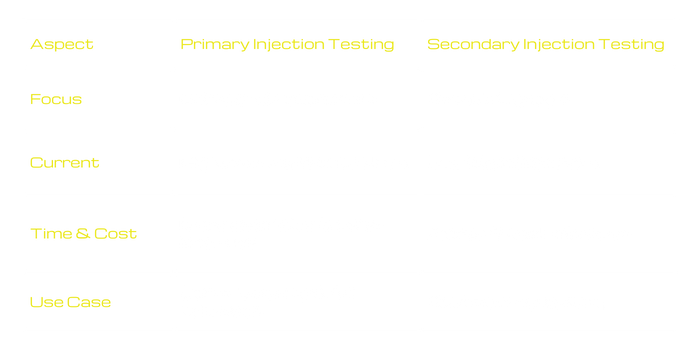
Key Differences Between Primary and Secondary Testing
Industry Standards and Compliance
AIS Electrical Engineers must comply with global and local standards, such as:
- IEC 61850 – Communication and automation systems
- IEEE C37 – Relay testing and protection
- Local Safety Codes – Country-specific regulations
Tools and Equipment
- Primary Injection Test Kits – Provide high current for full-system tests.
- Secondary Injection Test Kits – Deliver precise low-level signals.
- Advanced Digital Systems – Offer automated reporting and analysis.
Step-by-Step Process of Conducting Testing
- Safety First – Isolate equipment and apply lockout/tagout.
- Perform Test – Inject current/signals as per procedure.
- Record Data – Capture breaker response and relay action.
- Analyze Results – Compare against standards and specs.
Common Challenges and Troubleshooting Tips
- Equipment Limitations – Ensure proper test kit capacity.
- Calibration Errors – Maintain and calibrate test devices.
- Misinterpretation – Provide staff training to avoid errors.
Best Practices for AIS Electrical Engineers
- Test at regular intervals for preventive maintenance.
- Maintain engineer certifications in testing procedures.
- Leverage digital test systems for higher accuracy and speed.
FAQ’s
Q1: Why are both primary and secondary injection tests necessary?
Because they complement each other – primary validates the full chain, while secondary checks relay logic.
Q2: Q2: How often should Injection Testing be done?
Typically every 1–3 years, depending on system criticality and regulations.
Q3: Can secondary injection replace primary injection?
No. It only validates part of the system, not the full protection chain.
Q4: How long does primary injection testing take?
Several hours due to setup, safety checks, and execution.
Q5: Are digital test kits better than manual kits?
Yes. They provide better accuracy, automation, and reports.
Q6: What safety steps should be followed during Injection Testing?
Always use PPE, isolate equipment, and follow lockout/tagout procedures.
Conclusion
For AIS Electrical Engineers, mastering Injection Testing is essential for safe and reliable power systems. While Primary Injection Testing validates the full protection chain, Secondary Injection Testing provides quick relay verification. Together, they create a comprehensive maintenance strategy that protects both equipment and personnel.
Need more information?
Contact Us
Address
Unit 30, Sildale Park, 150 Conveyer Rd, Silvertondale, Silverton, 0181
Phone
+27 (0)12 012 6173
Follow Us










Brandon and his team are professional, responsive, and genuinely care about meeting our needs. Communication is clear and timely, and they go above and beyond to make sure everything is handled smoothly.
Highly recommend 💯

What really stands out is how little input they need to get things spot on. The service is always professional but still friendly and easy to work with, which is why they’re my go-to team whenever I need a control panel built, no matter the size.
Keep up the awesome work, AIS!